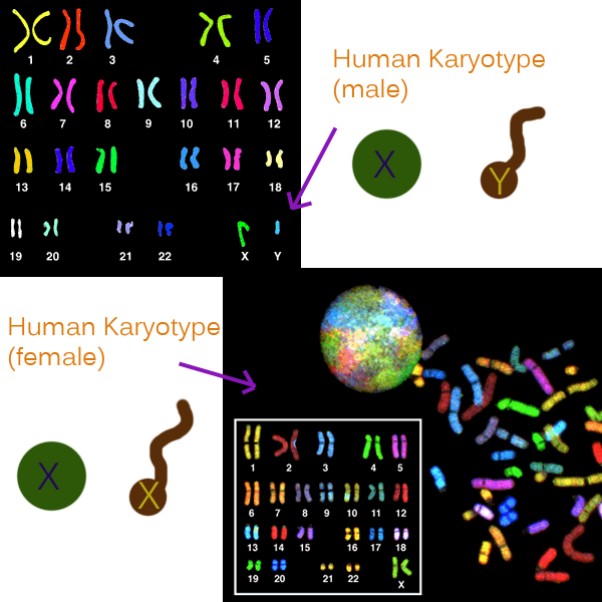
In a normal human, there are 23 pairs of chromosomes, making a total collection of 46 as shown in the karyotypes below. In a female human, all chromosome pairs are symmetrical, but in a male, the 23'd pair is asymmetrical. The Y-chromosome is visibly smaller than the X-chromosome.
Since both males and females have at least one X chromosome, but only males have Y-chromosomes. If you are a male, then you know that your Y-chromosome came from your father and your X-chromosome came from your mother. If you're a female, you got an X-chromosome from each parent.
So a sperm cell is heterogametic (capable of carrying an X or a Y), but an egg only carries an X, so a human female is homogametic. This system is reversed in birds, where the female is heterogametic (ZW) and the male is homogametic (ZZ).
Equality of the Sexes starts in Utero:
Sex determination is like a coin flip. You have an equal probability of being born female as you do male, since a sperm has a 50% of carrying an X or a Y, and an egg is virtually certain to be carrying an X. The actual mechanics that determine sex depend on two things:
Firstly, a sperm will acquire either an X or a Y by the end of meiosis (sperm production). Meanwhile, an egg cell can only acquire an X by the end of meiosis (egg production).
Secondly, a sperm with either an X or a Y will latch penetrate the membrane of the egg before the other sperms do. Then the sperm's "head" is absorbed into the egg and the other sperms are left to die in the toxic environment of the now-fertile uterus.
In evolutionary "economics," it makes sense that both sexes are equally valuable and interdependent in terms of promoting the survival and refinement of our DNA. Since each zygote is a chromosomal scramble of maternal and paternal DNA (in equivalent portions), there's a higher out-put of mutations (and within that set, adaptive mutations) than there is from asexual reproduction.
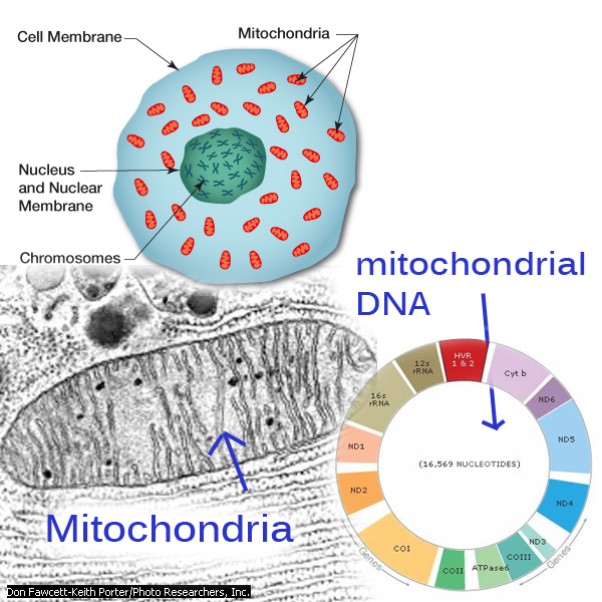
Inside each of our cells are a collection of robotic workers called organelles ("tiny organs") housed inside the cell. The nucleus is the easiest component of a cell to see under a microscope since it's the largest. But if we zoom in closer we can see the mitochondria, which are actually bacteria cells living inside our cells! It has it's own mitochondrial DNA in the form of a plasmid (a ring composed of genetic material found in bacteria). We rely on our mitochondria to metabolize our food and provide us the energy to live and go about our days.
Why is mitochondrial DNA relative to sex determination?
Like paternal Y-chromosome lineage, a person's mitochondrial DNA marks his or her maternal lineage, since mitochondria are only produced after a fetus develops at a certain point in the uterus. Your mitochondrial DNA can give you information about your grandmothers and your Y-chromosomes can tell you about your grandfathers. For example, you can trace which genetic traits (and actual genetic fragments) came from which people.
Created by Karlina Beringer. Updated August 6, 2010.